

Affordable housing projects are often discussed in terms of units, design, or funding sources. But long before any of those decisions are finalized, one factor has an outsized influence on the entire project: income limits. Area Median Income (AMI) thresholds shape rent levels, operating revenue, financing options, and long-term compliance obligations.
Because of this, affordability decisions are not simply policy choices. They are structural decisions that affect every part of a project’s lifecycle.
What AMI Really Represents
AMI is a benchmark published annually by HUD that reflects median household income for a specific geographic area. It varies by location and household size, and it serves as the foundation for determining eligibility and rent limits in affordable housing programs.
When a project is described as serving households at 30%, 50%, or 60% of AMI, it is not just a statement of intent. It establishes the maximum income residents can earn and, by extension, the maximum rent the project can charge.
These limits are central to understanding whether a project can support its costs over time.
How the AMI Matrix Shapes Financial Reality
Each AMI level carries different implications for revenue and operations. Lower AMI targets generally mean lower rents, which reduces operating income. Higher affordability often requires deeper subsidies or additional support to remain feasible.
For example, a project serving households at 60% AMI may generate enough revenue to support conventional financing when paired with the right incentives. A project targeting 30% AMI will almost always require layered subsidies and long-term operating support.
This is why affordability levels cannot be selected in isolation. They must be evaluated alongside development costs, operating expenses, and available funding tools.
Affordability Mix Is as Important as Affordability Level
Many projects do not serve a single AMI level. Instead, they rely on a mix of income targets to balance mission goals with financial stability.
Common approaches include:
serving a majority of units at moderate affordability while reserving some units for deeper affordability
using income averaging to allow a range of incomes while maintaining an overall affordability requirement
aligning unit mix with household sizes most common in the area
These decisions affect unit sizing, design efficiency, and long-term operating performance.
AMI Decisions Affect More Than Housing Policy
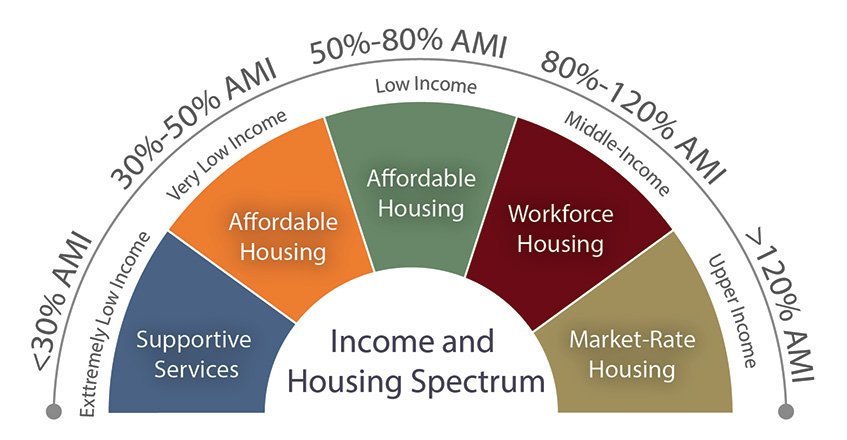
Income limits shape far more than who can live in a project. They influence:
which financing tools are available
how much equity can be raised
what compliance requirements apply
how long affordability restrictions last
how flexible operations will be over time
Once an AMI structure is selected, it is difficult to change without significant consequences. Early planning ensures these commitments are made intentionally rather than by default.
Why AMI Is Often Misunderstood Early On
AMI can feel abstract, especially at the concept stage. Projects may reference “affordable housing” broadly without defining income targets. This can lead to assumptions that are later challenged when funding or compliance requirements are introduced.
When AMI is not addressed early, projects may discover that:
projected rents are too high to qualify for certain programs
operating income is too low to support debt
unit mix does not align with household needs
subsidy requirements are deeper than expected
Early clarity prevents these misalignments.
AMI and Geography Matter Together
AMI is location-specific. A 60% AMI income limit in one city may look very different in another. Geography affects not only income limits, but also achievable rents, demand, and operating costs.
Understanding how AMI interacts with local market conditions is essential. A project that works financially in one neighborhood may struggle in another, even with the same affordability targets.
How Early Planning Strengthens Affordability Outcomes
Early-stage planning allows project sponsors to:
evaluate multiple AMI scenarios
understand trade-offs between affordability and feasibility
align income targets with funding tools
test long-term operating sustainability
ensure affordability commitments match community needs
This approach supports projects that are both mission-aligned and financially durable.
Why AMI Decisions Are a Turning Point
AMI decisions mark a shift from concept to commitment. They define who the project serves and how it must operate for decades to come. When these choices are made thoughtfully, they strengthen both community impact and project stability.
Understanding how income limits shape projects is not just about compliance. It is about building housing that works - financially, operationally, and socially - over the long term.
How River & Main Approaches AMI Strategy
River & Main works with projects early to translate affordability goals into realistic structures. Rather than treating AMI as a compliance box to check, we view it as a design and financial framework that deserves careful attention.
Our approach includes:
evaluating local AMI data and trends
modeling different affordability scenarios
aligning AMI targets with funding strategies
identifying long-term operational impacts
helping partners understand trade-offs clearly
Affordable housing outcomes are strongest when income limits are chosen deliberately and early - not when they are imposed late in the process.
